Monday, 10 January 2022
10:35 PM
Perl is not dead [blogs.perl.org] 10:35 PM, Monday, 10 January 2022 05:40 PM, Monday, 10 January 2022
Came across an interesting video from one of the users of Perl: Is Perl dead? @Randal L. Schwartz on Dart and Flutter @Code Maven
05:41 PM
To whom this MySQL UTF-8 news may concern [blogs.perl.org] 05:41 PM, Monday, 10 January 2022 06:00 PM, Monday, 10 January 2022
Strictly speaking not news exactly, given that it dates from early 2018, but it was news to me, and since I haven’t seen it make the rounds I still find it worth disseminating. From the MySQL 8.0.11 release notes:
The
utf8mb3character set will be replaced byutf8mb4in a future MySQL version. Theutf8character set is currently an alias forutf8mb3, but will at that point become a reference toutf8mb4. To avoid ambiguity about the meaning ofutf8, consider specifyingutf8mb4explicitly for character set references instead ofutf8.
This a declaration of intent rather than a change that has happened… but still. It’s been a very long September…
(To prepare for this you’ll want to note
what you need to take into account regarding the way
utf8mb4 and indexes interact.)
07:58 AM
TWC 146: 10K Prime and CW Trees [blogs.perl.org] 07:58 AM, Monday, 10 January 2022 03:00 AM, Monday, 10 January 2022
In which we leap tall primes in a single bound, mis-take a tree, test percussion, and find the limits of a Curious Module.
Task 1: 10001st Prime Number - One-liners (expanded) in Raku and Perl.
Task 2: Curious Fraction Tree - Solutions in Raku and Perl (with 200+ tests), and another Perl solution using a CPAN module.
TWC Task #1, 10001st Prime Number
Perl
My Perl program is a 3-line version of this one-liner:
perl -Mntheory=nth_prime -wE 'say nth_prime(10_001)'
The ntheory
(Number Theory) module has many routines that would solve the
problem. nth_prime is the most direct.
Raku
constant @primes = (2, 3, 5, 7 ... *).grep(&is-prime);
say @primes.skip(10_000).head;
That
first line creates a "constant" lazy infinte array of primes.
It is constant in the sense that the program code cannot alter a
value, but it is lazy, so the elements of
@primes[0..N] are not generated until something tries
to use @primes[N]. All the prior elements are cached
and delivered on request without recalculation. If a higher element
is requested later in the program's execution, then the generation
of @primes elements will resume where it left off.
TWC Task #2, Curious Fraction Tree
I studied the patterns of parent->children and child->parent, slung some code to solve the task, wrote more to extend the tree, and searched OEIS and the Web.
Observations:
-
The "Curious Fraction Tree" is properly named the "Calkin-Wilf Tree", but is easily confused with the 150+year-earlier "Stern-Brocot tree".
(by "easily confused", I mean that I confused them. Also confused C-W with Kepler's tree of harmonic fractions.) -
Coolest illustration of the C-W tree: https://www.jasondavies.com/calkin-wilf-tree/
-
C-W tree covers every rational number.
(Infinite in two dimensions? No big deal, I can do that easily via diagonals; we just get lots of duplicates.)- C-W tree does not need diagonals, and never has
duplicates.
- ...I can't do that.
- Apparently, I can't even understand the proof!
- ...I can't do that.
- C-W tree does not need diagonals, and never has
duplicates.
-
Raku has rational numbers as a built-in type: Rat. Rat is auto-normalizing (3/6 becomes 1/2), has .numerator and .denominator methods, and a .nude method to get a list of both (Nu/De) at once.
-
If you follow a fraction's C-W lineage all the way back to (but not including) the 1/1 root, reverse that lineage to be root-to-descendant, and map each fraction along-the-way as proper-fraction==L, improper-fraction==R (i.e. more than 1 or less than 1), then you get a navigation tree of which branch to follow, all the way to the original number. e.g. 8/19 has the navigation of RLRRLL.
- To a percussionist, those navigations look just like snare drum
rudiments and exercises: 'RLRRLL' is a
single paradiddle-diddle
- Those navigations can translate back-and-forth (if we are careful) to binary numbers, and so to plain decimal integers. (More on this when I discover the Curious Module below.)
- To a percussionist, those navigations look just like snare drum
rudiments and exercises: 'RLRRLL' is a
single paradiddle-diddle
-
Exploring the tree via regular patterns of L(s) and R(s) finds some interesting properties:
- 'LLLLLL'... and 'RRRRRR'... are the left and right edges of the
tree, with top or bottom == 1.
1/101 # 'L' x 100
101/1 # 'R' x 100 - R,'LLLLLL'... and L,'RRRRRR'... are the two center-most numbers ("framing" the half-way point) on any level after the first. Top or bottom will be '2'.
- LR,'LLLLLL'... and LL,'RRRRRR'... frame the quarter-way
point;
RR,'LLLLLL'... and RL,'RRRRRR'... frame the three-quarter-way point on any level after the second. Top or bottom will be '3'. - (and so on, for row divisions by 8, 16, 32, ...)
- Single-bit set (or unset) produce the top (or bottom) sequence
2,3,4...(size+1) as we slide the position of the bit:
2/31 # RLLLLLLLLLLLLLLL
3/44 # LRLLLLLLLLLLLLLL
4/55 # LLRLLLLLLLLLLLLL
...
31/2 # LRRRRRRRRRRRRRRR
44/3 # RLRRRRRRRRRRRRRR
55/4 # RRLRRRRRRRRRRRRR - Alternating L and R reaches the 1/3-point and 2/3-point in a
row, producing approximations of the Golden Ratio
φ ("The most irrational number"; 1.618033988749...), and its
inverse|conjugate.
These numbers are all ratios of successive Fibonacci numbers.
e.g. LRLRLRLRLRLRLRLRLRL => 6765/10946 == F(20)/F(21) == 0.618034
- 'LLLLLL'... and 'RRRRRR'... are the left and right edges of the
tree, with top or bottom == 1.
After satisfying my urge for percussive exploration, I formalized the findings into a file of tests that the Perl and Raku solutions could both access, then wrote utility routines to help anyone who wants to explore more deeply.
I later found mention in a paper (URL?) that, unlike the Stern-Brocot tree, the C-W tree can be navigated directly across a row, also moving from the end of one row to the start of the next row. I added the calculation to the utility routines as `next-Calkin-Wilf-neighbor.
After all that, I found a Perl module on CPAN that solves the problem: Math::PlanePath::RationalsTree. This lead to a proof-of-concept one-liner, that calculates the parent but not the grandparent:
perl -MMath::PlanePath::RationalsTree -wE 'my $CW = Math::PlanePath::RationalsTree->new( tree_type => "CW" ); say join "/", $CW->n_to_xy( $CW->tree_n_parent( $CW->xy_to_n(@ARGV) ) );' 4817 5410
I cloned my original Perl solution and replaced my algorithm with calls to the module, as ch-2viamodule.pl, so I could be sure that the module could play in my drumming circle.
It worked perfectly, except where it didn't. Of 202 tests, only 166 passed.
Looking deeper into the 36 test failures, the problem became obvious. The module handles all types of rational trees with the efficient method of translating the LR navigation into zeros and ones to make (when decoded from binary) an integer. That integer represents the linear position of the rational.
$ perl -MMath::PlanePath::RationalsTree -wE 'my $CW = Math::PlanePath::RationalsTree->new( tree_type => "CW" ); say "N=$_ : tree_element=", join "/", $CW->n_to_xy( $_ ) for 1..5;'
N=1 : tree_element=1/1
N=2 : tree_element=1/2
N=3 : tree_element=2/1
N=4 : tree_element=1/3
N=5 : tree_element=3/2
The tree gets twice as big for every row (level?) you go down. Exponential growth! Around row 64, N will be around 2^64, and overflow the integer size of 64-bit Perl. All the tests below N=2^64 passed, as did some beyond that point (vagaries of rounding?), but you cannot rely on accuracy past that point. E.g.: finding the parent of "1/65" gives the wrong answer using the "convert to N" method, while 1/10001 and beyond all work with the direct calculations in Perl and Raku. (To be fair, Raku starts having problems past level 90 when drilling down along the Golden Ratio, due to Rat auto-collapsing into a more efficient Num. This could be prevented by using FatRat.)
Raku
Of note in my Raku solution :
- Clean separation of types: Calkin-Wilf-tree-parent() takes and returns Rat, and task2() takes and returns Str.
- Symmetry: task2() splits on slash at the start, and joins on slash at the end.
- Sequence: @lineage is a lazy Seq going all the way back to
the root, generated by repeated calls to get the parent of the last
result. This "keep feeding the result back in as the next argument"
(iterated function) is a common-enough pattern that Raku directly
supports it via the
...or "sequence" operator. Since the Seq is lazy, and we only ask for the first two ancestors (via .head), only two are calculated. - Contain to Name: Placing the difference in its own variable
allows not only DRY in the return statement, but also the symmetry
between the two possible results. I particularly like how
diffand-diffread, compared ton-dand d-n. (If I had not already committed, I might changediff/dto+diff/dto call attention the sign change). - multi sub MAIN clearly shows the two ways to run the program.
Perl
Of note in my Perl solution :
- Clean separation of types: CalkinWilftree_parent() takes and returns a two-element [numerator,denominator] arrayref, and task2() takes and returns a "numerator/denominator" string.
- map==grep++ :
mapis also serving asgrepvia the empty-list trick; if no non-whitespace characters exist in the line, thenmapproduces nothing for that line, not evenundef; the line is skipped. - /r : Using the
rmodifier (part of s{...}{...}msxr) on the substitution lets me return a changed copy, instead of modifying the original.
Kudos to manwar, and thanks to the whole team at The Weekly Challenge!
Elwood:
What kind of music do you usually have here?
Claire: Oh, we got both kinds. We got Country and
Western.
Rawhide!
12:57 AM
Perl Weekly Challenge 146: Prime Numbers and Fraction Tree [blogs.perl.org] 12:57 AM, Monday, 10 January 2022 11:00 PM, Sunday, 09 January 2022
These are some answers to the Week 146 of the Perl Weekly Challenge organized by Mohammad S. Anwar.
Spoiler Alert: This weekly challenge deadline is due in a few days from now (on January 9, 2022 at 24:00). This blog post offers some solutions to this challenge, please don’t read on if you intend to complete the challenge on your own.
Task 1: 10001st Prime Number
Write a script to generate the 10001st prime number.
10001st Prime Number in Raku
Raku has a fast is-prime subroutine or method, using the Miller-Rabin algorithm, to test whether a integer is prime. We can just generate an infinite (lazy) list of prime numbers and look for the 10000st one.
use v6;

my @primes = grep { .is-prime }, (1, 2, 3, -> $a { $a + 2} ...Inf);
say @primes[10001 - 1];  # Subtract 1 because the array starts at 0
This script displays the following output:
$ raku ./10001prime.raku
104743
The Raku script is so simple that it can be implemented as a short Raku one-liner:
$ ./raku -e 'say (grep { .is-prime }, 1..Inf)[10000]'
104743
10001st Prime Number in Perl
Since Perl doesn’t have a built-in is-prime
subroutine, we implement our own. As finding the first 10001 primes
is an intensive computation, we implement three performance
optimizations compared to the naive brute-force solution: first,
with the exception of 2, we only check odd integers. Second, we
limit the tested divisors to the square root of the integer being
checked. Finally, rather than testing all possible divisors, we
test only the primes that we have already found. With these three
optimizations, the script runs in less than 0.2 second, much faster
than I expected.
use strict;
use warnings;
use feature "say";
use constant MAX => 10_001;

sub primes {
    my $max = shift;
    my @primes = (2, 3, 5);
    my $count = 3;
    my $candidate = $primes[-1];
    while ($count <= $max) {
        $candidate += 2;
        my $not_prime = 0;
        my $sq_cand = sqrt $candidate;
        for my $i (@primes) {
            $not_prime = 1, last unless $candidate % $i;
            last if $i > $sq_cand;
        }
        next if $not_prime;
        push @primes, $candidate;
        $count ++;
    }
    return $primes[$max-1];
}
my $p = primes(MAX);
say "$p";
This script displays the following output:
$ time perl ./10001prime.pl
104743

real    0m0,192s
user    0m0,124s
sys     0m0,077s
10001st Prime Number in Ring
I continue my exploration of Ring, a recent programming language (the first version was issued in 2016). The Ring implementation below is essentially a port of the Perl program above (with same performance optimizations):
p = primes(10001)
see p + nl

func primes max
    primes = [2, 3, 5]
    count = len(primes)
    candidate = primes[count]
    while count < max
        candidate += 2
        is_prime = True
        sqrt_cand = sqrt(candidate)
        for i in primes
            if candidate % i = 0
                is_prime = False
                exit
            ok
            if i > sqrt_cand exit ok
        next
        if is_prime
            add(primes, candidate)
            count ++
        ok
    end
    return primes[max]
This program displays the following output:
$ ring ./10001prime.ring
104743
Note that Ring lists start with subscript 1, so we use index 10001 for finding the 10001 ptime number.
10001st Prime Number in Julia
function getprimes(max)
    primes = [2, 3, 5]
    count = 3
    candidate = 5
    while (count <= max)
        candidate += 2
        not_prime = false
        sq_cand = sqrt(candidate)
        for i in primes
            if (candidate % i == 0)
                not_prime = true
                break
            end
            i > max && break
        end
        not_prime && continue
        push!(primes, candidate)
        count += 1
    end
    return primes[max] # Julia arrays start with index 1
end

p = getprimes(10001)
println(p)
This program displays the following output:
$ julia 10001prime.jl
104743
Task 2: Curious Fraction Tree
Consider the following Curious Fraction Tree:
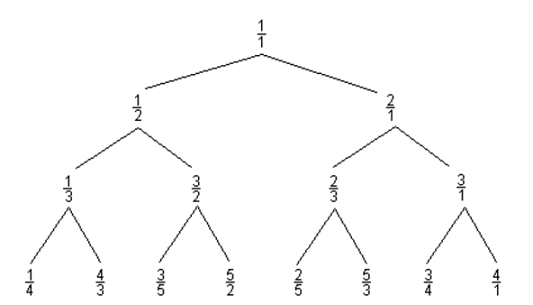
You are given a fraction, member of the tree created similar to the above sample.
Write a script to find out the parent and grandparent of the given member.
Example 1:
Input: $member = '3/5';
Output: parent = '3/2' and grandparent = '1/2'
Example 2:
Input: $member = '4/3';
Output: parent = '1/3' and grandparent = '1/2'
The first problem is to understand how this tree is constructed.
Each fraction has two children. It is easy to see that the left child is always a number smaller than 1 and the right child is always a number larger than 1. But how are the values generated?
Well, it is probably not so difficult to find out, but I must confess that I did not try very hard to find the constructing rules, but found them on the Curious Fraction Tree Web page. They are explained in this diagram:
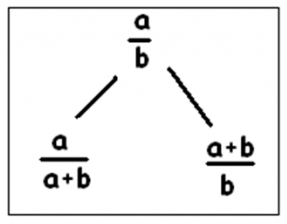
In other words, we have the following rules:
- For any node, the left child is less than 1 et the right child larger than 1;
- For node
a/b, left child isa/(a+b)and right node is(a+b)/b.
From these two rules, it is easy to derive the reciprocal rules for finding the parent of a node:
- For a node
x/ywith a fraction less than 1, the parent isx/(y-x); - For a node
x/ywith a fraction larger than 1, the parent is(x-y)/x.
It is now very easy to implement these rules in various programming languages.
There is, however, one little last problem. The task
specifications do not tell us what to do about invalid input. For
example, if the input is (1, 1) (the root to the
tree), we will not be able to find a parent. Similarly, if we are
given (1/2) as input, we will find (1, 1)
as the parent, and will not be able to the grand-parent. We would
have a problem if one of the values is 0. It is fairly easy to
detect these problems, but I still wouldn’t know what to do
about it. In many of the implementations below, I have decided that
we must be given a valid input and will not try to validate the
input. In some others, I have decided to detect some of these
invalid input problems and tried to do something reasonable about
them.
Curious Fraction Tree in Raku
We’re just implementing the rules above. Here, I do not try to validate the input.
Note that I was first tempted to implement the fraction as a
Rat type of value, since it implements it as a
numerator/denominator pair. I finally decided not to do that
(because there may be some cases where the fraction might be
reduced to their simplest form, division by 0 errors, and other
such problems). So I decided to implement the fractions as integer
pairs.
use v6;

# for a node x/y less than 1, parent is x/(y-x)
# for a node x/y larger than 1, parent is (x-y)/x

sub parent (\num, \denom) {
    return num < denom ?? (num, denom - num) !! (num - denom, denom);
}
for (5, 2), (2, 5), (3, 4), (3, 5) -> $fraction {
    my $parent = parent |$fraction[0,1];
    my $gd-parent = parent |$parent[0,1];
    say "for child $fraction, parent is $parent and gd-parent is $gd-parent";
}
With the test fractions provided in the code, this program displays the following output:
raku ./fraction-tree.raku
for child 5 2, parent is 3 2 and gd-parent is 1 2
for child 2 5, parent is 2 3 and gd-parent is 2 1
for child 3 4, parent is 3 1 and gd-parent is 2 1
for child 3 5, parent is 3 2 and gd-parent is 1 2
Curious Fraction Tree in Perl
This program implements the rules described above. Here, we have made some effort to validate the input, just as an example: we write an error value if we get pas the root node.
use strict;
use warnings;
use feature "say";

# for a node x/y less than 1, parent is x/(y-x)
# for a node x/y larger than 1, parent is (x-y)/x

sub parent {
    my ($num, $denom) = @{$_[0]};
    return ["Error"] if $num == $denom;
    return $num < $denom ? [$num, $denom - $num] : [$num - $denom, $denom];
}

for my $fraction ([5, 2], [2, 5], [3, 4], [3, 5], [2, 1], [1, 1]) {
    die "Invalid input node @$fraction" if $$fraction[0] == $$fraction[1];
    my $parent = parent $fraction;
    my $gd_parent = parent $parent;
    say "for child @$fraction, parent is @$parent and gd-parent is @$gd_parent";
}
This program displays the following output:
$ perl ./fraction-tree.pl
for child 5 2, parent is 3 2 and gd-parent is 1 2
for child 2 5, parent is 2 3 and gd-parent is 2 1
for child 3 4, parent is 3 1 and gd-parent is 2 1
for child 3 5, parent is 3 2 and gd-parent is 1 2
for child 2 1, parent is 1 1 and gd-parent is Error
Invalid input node 1 1 at fraction-tree.pl line 15.
Curious Fraction Tree in Some Other Programming Languages
In Ring
Again the same rules as before, with an attempt to handle gracefully some of the exceptions:
# for a node x/y less than 1, parent is x/(y-x)
# for a node x/y larger than 1, parent is (x-y)/x

for test in [ [5, 2], [2, 5], [3, 4], [3,5], [6, 2], [1, 2] ]
    parent = find_parent(test[1], test[2])
    gd_parent = find_parent(parent[1], parent[2])
    see "Node " + to_str(test) + " has parent " + to_str(parent) +
        " and grand-parent " + to_str(gd_parent) + nl
next

func find_parent num, denom
    if num < denom
        return [num, denom - num]
    but denom < num
        return [num - denom, denom]
    else
        return ["Error", ""]
    ok

func to_str input
    return "" + input[1] + " " + input[2]
This script displays the following output:
$ ring ./fraction-tree.ring
Node 5 2 has parent 3 2 and grand-parent 1 2
Node 2 5 has parent 2 3 and grand-parent 2 1
Node 3 4 has parent 3 1 and grand-parent 2 1
Node 3 5 has parent 3 2 and grand-parent 1 2
Node 6 2 has parent 4 2 and grand-parent 2 2
Node 1 2 has parent 1 1 and grand-parent Error
In Python
No attempt here to validate the input.
# for a node x/y less than 1, parent is x/(y-x)
# for a node x/y larger than 1, parent is (x-y)/x

def find_parent(num, denom):
    return [num, denom - num] if num < denom else [num - denom, denom]

for test in ([5, 2], [2, 5], [3, 4], [3, 5]):
    parent = find_parent(test[0], test[1])
    gd_parent = find_parent(parent[0], parent[1])
    print("Node", test, "has parent", parent, "and grand-parent", gd_parent)
Output:
$ python3 ./fraction-tree.py
Node [5, 2] has parent [3, 2] and grand-parent [1, 2]
Node [2, 5] has parent [2, 3] and grand-parent [2, 1]
Node [3, 4] has parent [3, 1] and grand-parent [2, 1]
Node [3, 5] has parent [3, 2] and grand-parent [1, 2]
In Julia
Limited attempt to validate the input (catching only some of the exceptions).
function find_parent(num, denom)
    return num < denom ? [num, denom - num] :
           num > denom ? [num - denom, denom] :
           ("Error on node $num $denom");
end

for test in [ [5, 2], [2, 5], [3, 4], [3, 5], [1, 2] ]
    parent = find_parent(test[1], test[2])
    gd_parent = find_parent(parent[1], parent[2])
    println("Node $test has parent $parent and grand-parent $gd_parent")
end
Output:
# Node [5, 2] has parent [3, 2] and grand-parent [1, 2]
# Node [2, 5] has parent [2, 3] and grand-parent [2, 1]
# Node [3, 4] has parent [3, 1] and grand-parent [2, 1]
# Node [3, 5] has parent [3, 2] and grand-parent [1, 2]
# Node [1, 2] has parent [1, 1] and grand-parent Error on node
In Awk:
# Run for example as:
# echo ' 5/2
# 2/5
# 3/5' | awk -f fraction-tree.awk
function parent()
{
    if (a < b) {
        b = b - a
    } else {
        a = a - b
    }
}
BEGIN {
    a = 0
    b = 0
    FS = "/"
}
{
    a = $1
    b = $2
    printf "Node = %d/%d: ", a, b
    parent()
    printf "Parent = %d/%d; ", a, b
    parent()
    printf "Grand-parent = %d/%d\n", a, b
}
Output:
$ echo ' 5/2
2/5
3/4
3/5
6/2 ' | awk -f fraction-tree.awk
Node = 5/2: Parent = 3/2; Grand-parent = 1/2
Node = 2/5: Parent = 2/3; Grand-parent = 2/1
Node = 3/4: Parent = 3/1; Grand-parent = 2/1
Node = 3/5: Parent = 3/2; Grand-parent = 1/2
Node = 6/2: Parent = 4/2; Grand-parent = 2/2
In Ruby
# For a node `x/y` with a fraction less than 1, the parent is `x/(y-x)`;
# For a node `x/y` with a fraction larger than 1, the parent is `(x-y)/x`.

def get_parent (pair)
    num = pair[0]
    denom = pair[1]
  return num < denom ? [num, denom - num] : [num - denom, denom];
end

tests = [ [5, 2], [2, 5], [3, 4], [3,5] ]
for test in tests
    parent = get_parent(test)
    gd_parent = get_parent(parent)
    print("Node #{test} - Parent: #{parent} - Grand-Parent: #{gd_parent}\n")
end
Output:
Node 5,2 - Parent: 3,2 - Grand-Parent: 1,2
Node 2,5 - Parent: 2,3 - Grand-Parent: 2,1
Node 3,4 - Parent: 3,1 - Grand-Parent: 2,1
Node 3,5 - Parent: 3,2 - Grand-Parent: 1,2
In Lua
-- For a node `x/y` with a fraction less than 1, the parent is `x/(y-x)`;
-- For a node `x/y` with a fraction larger than 1, the parent is `(x-y)/x`.

local function get_parent(pair)
    num = pair[1]
    denom = pair[2]
    -- no ternary operator in Lua, we can simulate it with and / or:
    return num < denom and {num, denom - num} or {num - denom, denom}
end

local function to_str(pair)
    -- return pair[1] .. "/" .. pair[2]
    return table.concat(pair, "/")
end

local tests = { {5, 2}, {2, 5}, {3, 4}, {3,5} }
for _, test in pairs(tests) do
    parent = get_parent(test)
    gd_parent = get_parent(parent)
    print("Node " .. to_str(test) .. " - Parent: " .. to_str(parent)
        .. " - Grand-Parent: " .. to_str(gd_parent))
end
Output:
$ lua ./fraction-tree.lua
Node 5/2 - Parent: 3/2 - Grand-Parent: 1/2
Node 2/5 - Parent: 2/3 - Grand-Parent: 2/1
Node 3/4 - Parent: 3/1 - Grand-Parent: 2/1
Node 3/5 - Parent: 3/2 - Grand-Parent: 1/2
In Kotlin
fun find_parent(pair: IntArray): IntArray {
    val num = pair[0]
    val denom = pair[1]
    return if (num < denom) intArrayOf(num, denom - num) else intArrayOf(num - denom, denom)
}

fun n2str (pair: IntArray): String {
    return "${pair[0]}/${pair[1]}"
}

fun main() {
val tests  = arrayOf(intArrayOf(5,2), intArrayOf(2,5), intArrayOf(3,4))
    for (test in tests) {
        val parent = find_parent(test)
        val gd_parent = find_parent(parent)
        print(n2str(test) + " - Parent: " + n2str(parent))
        println(" - Grand-parent: " + n2str(gd_parent))
    }
}
Output:
5/2 - Parent: 3/2 - Grand-parent: 1/2
2/5 - Parent: 2/3 - Grand-parent: 2/1
3/4 - Parent: 3/1 - Grand-parent: 2/1
In C
#include <STDIO>
void parent(int *a, int *b) {
    if (*a < *b) {
        *b -= *a;
    } else {
        *a -= *b;
    }
}

int main (void) {
    int num, denom;

    while (scanf ("%d/%d", &num, &denom) == 2) {
        printf("%d/%d - ", num, denom);
        parent(&num, &denom);
        printf("Parent: %d/%d - ", num, denom);
        parent(&num, &denom);
        printf("Grand-parent: %d/%d \n", num, denom);
    }
    return (0);
}
Output:
$ echo ' 5/2
2/5
3/4
3/5' | ./a.out
5/2 - Parent: 3/2 - Grand-parent: 1/2
2/5 - Parent: 2/3 - Grand-parent: 2/1
3/4 - Parent: 3/1 - Grand-parent: 2/1
3/5 - Parent: 3/2 - Grand-parent: 1/2
In Scala
object fraction_tree extends App {

  def findParent(pair: List[Int]): List[Int] = {
    val num = pair(0)
    val denom = pair(1)
    return if (num < denom) List(num, denom - num) else List(num - denom, denom)
  }
  def n2str(pair: List[Int]): String = {
    return s"${pair(0)}" + "/" + s"${pair(1)}"
  }

  val tests: List[List[Int]] = List(List(5, 2), List(2, 5), List(3, 4))
  for (test <- tests) {
    val parent = findParent(test)
    val gd_parent = findParent(parent)
    println(n2str(test) + " - Parent: " + n2str(parent) + " - Grand-parent: " + n2str(gd_parent))
  }
}
Output:
5/2 - Parent: 3/2 - Grand-parent: 1/2
2/5 - Parent: 2/3 - Grand-parent: 2/1
3/4 - Parent: 3/1 - Grand-parent: 2/1
Wrapping up
The next week Perl Weekly Challenge will start soon. If you want to participate in this challenge, please check https://perlweeklychallenge.org/ and make sure you answer the challenge before 23:59 BST (British summer time) on January 16, 2022. And, please, also spread the word about the Perl Weekly Challenge if you can.